The One-Hour Weekly Review
Everyone has heard that you should work on the business, not just in it. Very few owners have a time on the calendar when that actually happens. One hour a week is enough if it goes to the right five things.

The week ends. You were busy every hour of it. And if somebody asked whether the business is in better shape than it was on Monday, you couldn't say.
That's the normal state of a one-person business, and it isn't a character flaw. The work in front of you is always louder than the work behind it. The fix isn't more discipline. It's one hour, at the same time every week, spent on five questions in the same order.
Pick the hour and protect it
Friday afternoon works for many people, because the week is still fresh. Sunday evening works for others, because the phone is quiet. The day matters less than the habit: the same hour every week, on the calendar, treated like a client appointment you wouldn't cancel.
Sit somewhere you won't do other work. Bring the laptop or the notebook you keep the business in. Then go through the five questions in order. The order is deliberate: money first, because money problems get worse while you wait.
1. Who owes you money? (15 minutes)
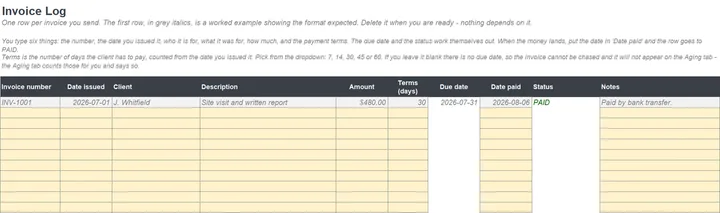
List every unpaid invoice and how old it is. Three things come out of this every week.
Anything past your terms gets a polite reminder today, not "next week". Anything finished but not yet invoiced gets invoiced now; work you haven't billed is work you did for free until you do. And anyone who is late for the second or third time gets a note in your client list, because the next quote to that client should account for it.
This is the part people skip, and it's the part that pays for the hour. If cash feels tight while the schedule is full, this is usually where it went: work done and not yet collected. (There's more on that in Booked Solid and Still Broke.)
2. What's going out? (10 minutes)
Look two weeks ahead. Bills due, insurance, the truck payment, supplies to reorder. Move your tax set-aside into its separate account if you haven't. Nothing here needs deciding. It needs seeing, so that nothing arrives as a surprise.
3. Is next week's schedule real? (10 minutes)
Go through next week day by day. Confirm anything unconfirmed. Look for the gap you could fill and the day you've overbooked. Check the weather for outdoor work. If someone is covering a job, make sure they have the job sheet.
The point is to find Tuesday's problem on Friday, while there's still time to do something about it.
4. What's waiting on an answer? (10 minutes)
Quotes you sent that nobody has answered. Leads you meant to call back. A client who said "maybe in the spring". Each one gets a follow-up or gets crossed off. A quote nobody follows up on is a quote you gave away to whoever called them next.
5. What's the one thing? (15 minutes)
The last fifteen minutes are the reason the hour exists. Ask one question: what is the one thing that, finished, would free me the most?
Not the urgent thing; the first four questions handled those. The thing that, once done, stops costing you time every week. Writing down your most common job so someone else can do it. Raising the price on the clients who have been underpriced for three years. Setting up the reminder that sends itself.
Pick one. Write it down. Put a block of time for it on next week's calendar, before anything else can claim that time. Then next week, in this same hour, check whether it got done.
Keep a one-line log
At the end of the hour, write one line in a running log: the date, what's owed to you, and the one thing. It takes thirty seconds.
After three months you'll have something no amount of being busy gives you: a record of whether the business is moving. You'll see whether what you're owed is shrinking or growing, and whether the one thing keeps getting done or keeps getting carried over.
When you miss a week
You will. Don't make it up by doing two hours the next week; you won't, and the habit dies of guilt. Just do this week's hour. The review only has to be good enough to happen.
The point
A business that never gets an hour of your attention as a business runs on whatever happened to you that week. One hour turns the week from something that happened to you into something you ran.
The work will still be loud on Monday. It will just be the right work.