How to Write Down a Job So Someone Else Can Do It
The first helper in a service business usually struggles for the same reason. The job was never written down, so they learn it by watching, get most of it right, and you quietly redo the rest.
The first helper in a small service business usually goes the same way. They ride along for a week or two and watch. Then they do the job on their own, and they get most of it right. You find the rest afterward: the bathroom fan they didn't wipe, the gate they left unlatched, the client who always wants the porch done first and noticed that it wasn't.
Nobody did anything wrong. The job was never written down, so it was learned the only way left, by watching. Watching passes on most of a job. The part it misses is the part that keeps clients.
The test a job sheet has to pass
Picture someone capable who has never been to this client's house. Could they do the job tomorrow, to your standard, with nothing but what's on the page?
If the answer is no, the job still lives in your head. That's true however long you've been doing it, and the longer you have, the more is in your head that you no longer notice.
What goes on one page
Keep it to one page per recurring job. A sheet nobody reads helps nobody.
Getting in. The address, where to park, the gate code, the lockbox, which door, the alarm, the dog's name and whether it gets let out. This is the part that stops a stranger cold, so put it first.
What done looks like. This is the hard part, and it's where most job sheets fail. "Clean the baseboards" is an instruction. "Baseboards wiped; run a finger along the top edge in the hallway and it comes up clean" is a standard. Write each item as something a person could check with their eyes or their hands.
The order. Most jobs have a sequence that saves time or keeps you from redoing work, like top to bottom, or back of the house to the front door. Write it down even if it feels obvious to you. It's obvious because you've done it two hundred times.
This client's specifics. The porch first. No bleach in the kitchen. The office door stays closed. The note on the counter means skip the guest room this week. Every client has three or four of these, and they're the ones they notice.
When something is wrong. Something broken, a door that won't open, a client who's home and unhappy. Write down who to call and what to do, so nobody has to guess on the spot.
How long it should take. A time range, not a number. It tells the person whether they're on pace, and it tells you whether the job was priced right.
Write it while you do the job
Don't write a job sheet at the kitchen table. You'll write down what you think you do, which isn't the same as what you do.
Instead, take your phone on the next visit and talk through the job as you go. "Parking on the street, not the drive. Code is on the sheet. Starting upstairs because the stairs get the dust last." Type it up that evening. The things you say out loud without thinking are exactly what a new person needs.
Test it before a client does
A job sheet is a draft until somebody other than you has used it.
First, give it to someone who has never done the job, a spouse or a friend, and ask them to walk you through what they'd do at each step. Wherever they hesitate or guess, a line is missing.
Then do a shadow run. The new person does the job from the sheet, and you come along and say nothing. Write down every question they ask you. Each question is a gap in the sheet, so fill it before the next visit.
It feels slow. It's a great deal faster than learning the gaps from client complaints.
Keep it alive
A job sheet goes stale the day a client changes something. Keep every sheet in one place, put a date at the top, and change it the same day the job changes, not "when you get to it".
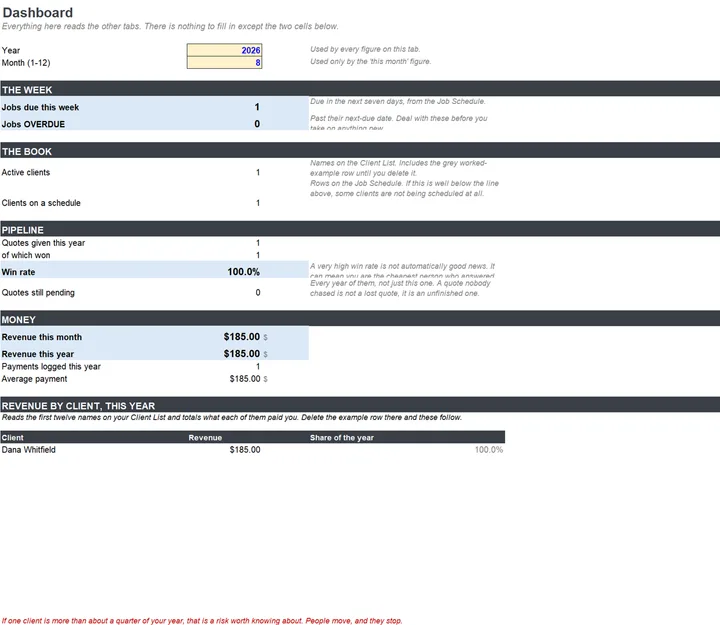
If your recurring jobs live in a tracker, link each client to their sheet. When the schedule says who's going where, the sheet should be one tap away.
Why it's worth the evening
You can't hire into a job that isn't written down. You can only hire someone to watch you, and that caps your business at the number of places you can be at once.
The same page that lets you hire also lets you take a week off, lets someone cover when you're sick, and makes the business worth something to a buyer someday. Most owners write their first job sheet when they're forced to, the week they're laid up and a client is waiting.
Write the first one this week, for your easiest recurring job. It will take an evening, and the second one will take half that.